
 Submit a find


 한국어
한국어 日本語
日本語 Español
 Français
 Deutsch
 简体中文
简体中文 繁體中文
繁體中文 Português
 Bahasa Indonesia
 ไทย
ไทย Italiano
 Tiếng Việt
 Türkçe
 Polski
 Русский
 Back to the lab
 JEVLAB NEWS Research & data
OpenAI Advances Mathematical Research with New Internal Model
AI-assisted summaries and translations. Check original sources for context and performance claims.
OpenAI reported that a new internal model has solved over 100 long-standing mathematical problems, including the Navier-Stokes millennium challenge. By utilizing approximately 10,000 AI agents working in parallel, the company achieved these results in just 24 days of training and development.
Translated summary · AI-assisted; check the original.
 Translated summary · AI-assisted; check the original.
The complete thread, at a glance
Independent AI-assisted summaries of CHOI’s connected posts. Images and videos belong to their original creators. Source claims have not been independently verified.
- Breakthrough in Mathematics
- New Advisory Group
- Iterative Training Process
- Previous Research Milestones
- Navier-Stokes Solution
- Collaborative Agent Architecture
- Hodge Conjecture Speculation
- Model Identity and Performance
- Automated Research Interns
- Evaluating Model Efficacy
- Academic Advisory Oversight
- Upcoming DevDay Expectations
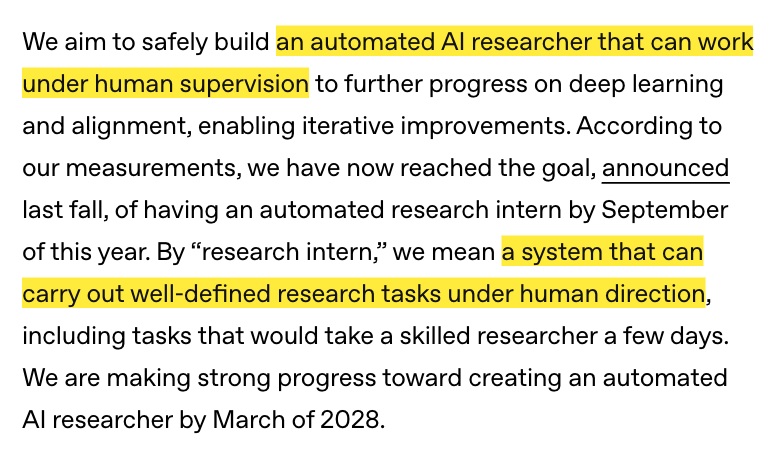
- Future of Research Automation
- Official Documentation
Breakthrough in Mathematics
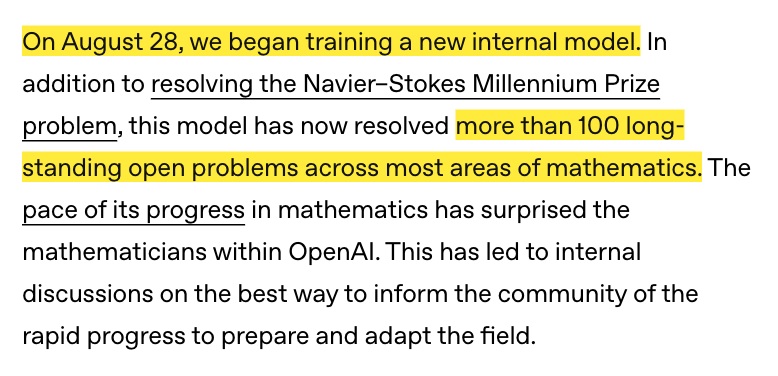
Choi reports that OpenAI's new internal model has successfully addressed over 100 long-standing mathematical challenges. This feat was accomplished by 10,000 AI agents working collaboratively over a 24-day period.
New Advisory Group
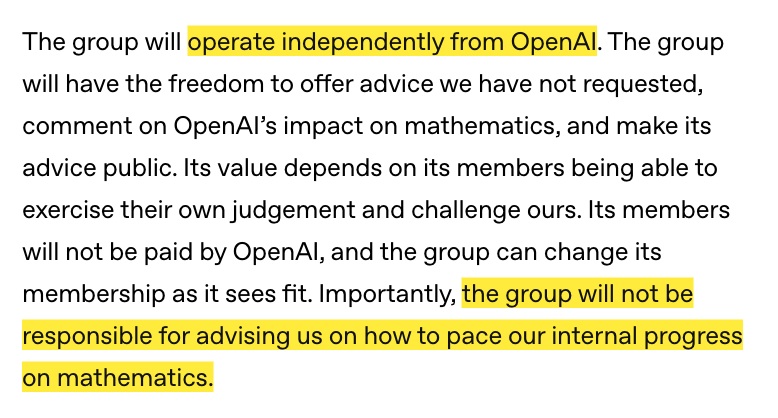
OpenAI announced these mathematical achievements on September 21. Due to the rapid pace of progress, the company has established an independent mathematics advisory group to oversee the disclosure and utility of these AI-generated findings.
Iterative Training Process
The research spanned 24 days, utilizing large-scale reinforcement learning on a pre-trained model. OpenAI continuously updated the agents with improved model versions throughout the process to optimize problem-solving efficiency.

Previous Research Milestones
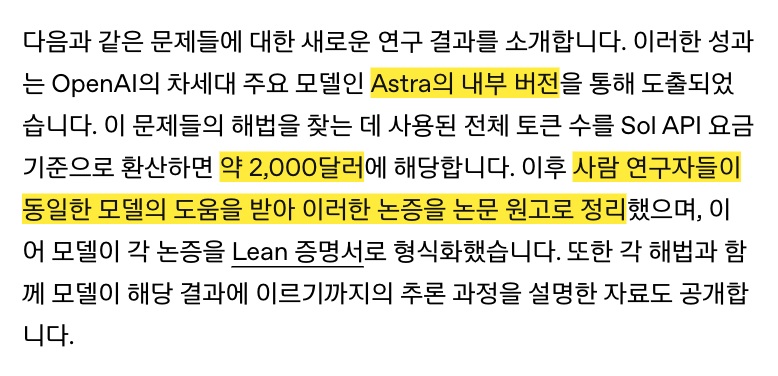
Prior to this, OpenAI showcased Astra's capabilities in fields like group theory and quantum complexity. These earlier efforts involved researchers formalizing AI-generated proofs into Lean, costing approximately $2,000 in API tokens.
Navier-Stokes Solution
On September 9, OpenAI announced the resolution of the Navier-Stokes millennium problem. The model provided a counterexample demonstrating that fluid flow can develop singularities where velocity increases infinitely while energy remains finite.
Collaborative Agent Architecture
The solution was not the work of a single model but a collective effort of 10,000 agents. Codex helped synthesize intermediate results, and the final proof was verified using the Lean formal verification tool.

Hodge Conjecture Speculation
Reports from The Information suggest OpenAI is nearing a solution to the Hodge conjecture. While unconfirmed, this indicates the model is simultaneously tackling diverse and complex mathematical domains.
Model Identity and Performance
While rumors mention a model called 'Bel,' OpenAI officially refers to the system only as a 'new internal model.' The company claims it significantly outperforms the previously known Astra model.
Automated Research Interns
OpenAI is moving toward 'automated research interns' capable of performing complex tasks. This capability extends beyond math to include writing research code, designing experiments, and analyzing results.
Evaluating Model Efficacy
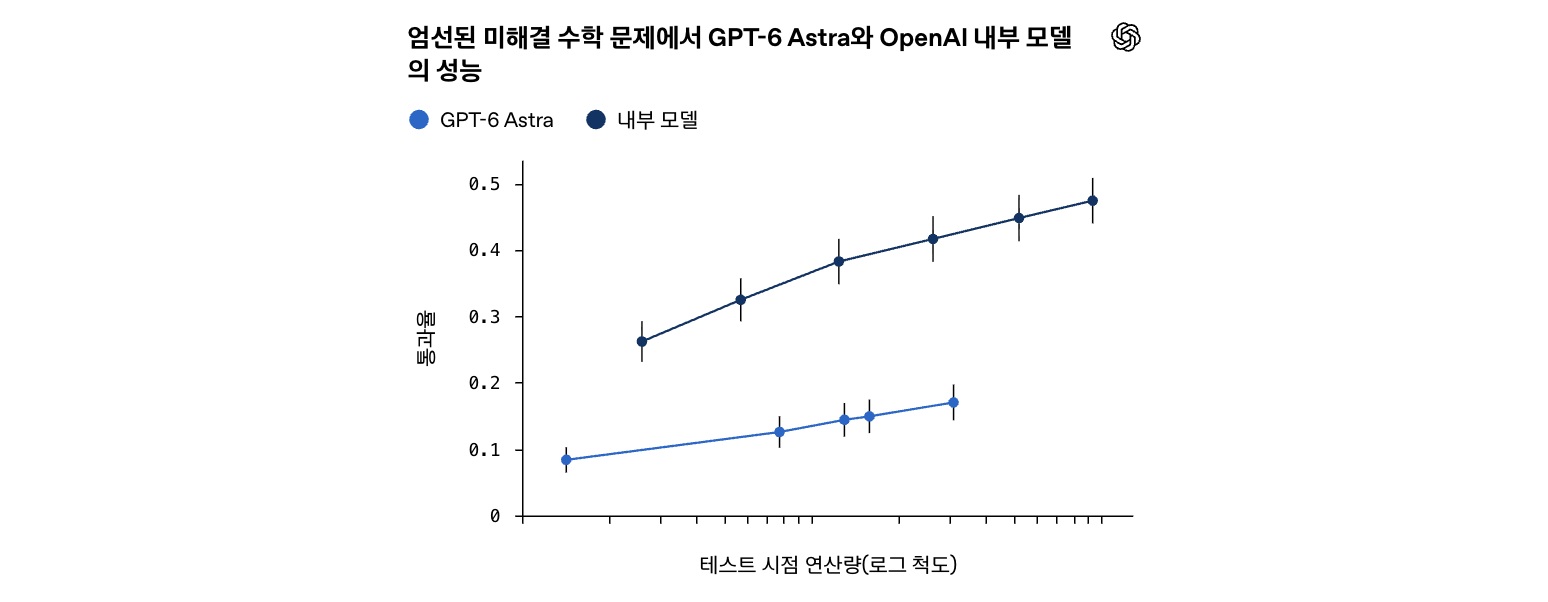
Experts like Jay Cummings and Mark Kisin emphasize the importance of success rates over raw output. OpenAI's internal evaluations show the new model maintains higher pass rates than Astra under similar computational loads.
Academic Advisory Oversight
The new advisory group includes prominent mathematicians like Timothy Gowers and Edward Witten. They will provide independent guidance on academic standards and the ethical disclosure of AI-generated mathematical proofs.
Upcoming DevDay Expectations
With OpenAI DevDay approaching on September 29, there is interest in whether these research methodologies will be integrated into public-facing products. The collaborative agent approach could significantly expand developer capabilities.

Future of Research Automation
Choi suggests the most significant impact will occur when these tools are available to external researchers. This could allow individual scientists to deploy thousands of agents to accelerate their own specific inquiries.
Official Documentation
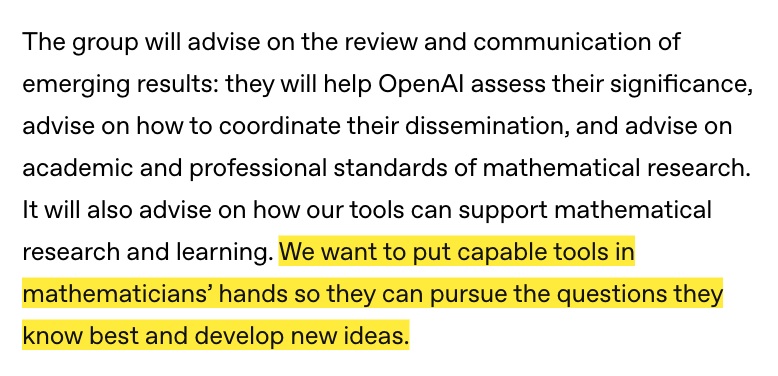
OpenAI has provided further details regarding their advisory group on mathematics and AI via their official website.
Source notes
This is a linked resource, not an independent verification of performance, cost or results. Check the original for current details.
- Collected
- 2026-09-22
- Discovered via
- www.threads.com
Top 10
Supporter
- Wallpets 104 clicks89d left
 W
W - Walltank 115 clicks89d left
 W
W - CChowder 66 clicks89d left
- Falconer 56 clicks89d left
 F
F - Lemonpod 93 clicks89d left
L
- Menta 40 clicks89d left
 M
M - Sway 37 clicks89d left
S
- Peon-Ping 33 clicks89d left
 P
P - Zeron 95 clicks89d left
 Z
Z - Guideless 30 clicks89d left
 G
G